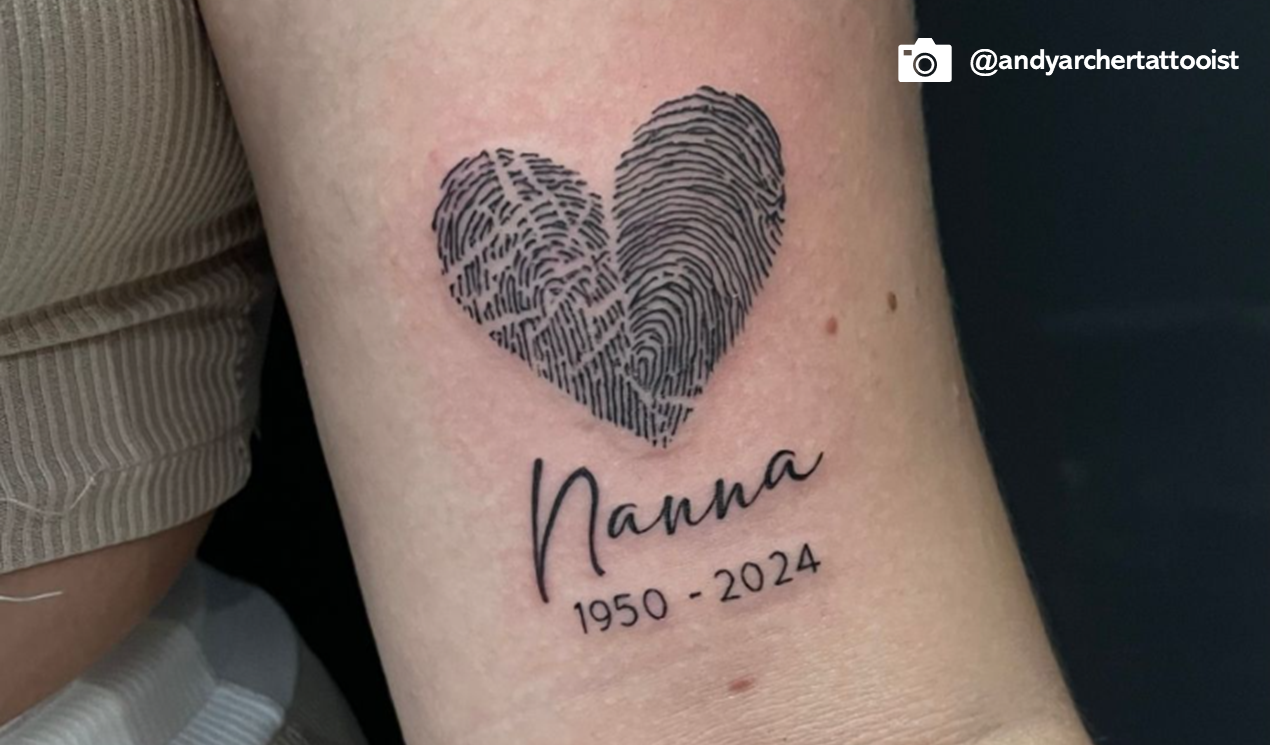
There is something quietly radical about deciding to carry someone with you on your skin. Not in a drawer, not in a photograph album, not in a digital folder you rarely open - but on your body, permanently, every day for the rest of your life.
Memorial tattoos have been around for as long as tattooing itself. Sailors inked anchors for lost crewmates. Families marked their grief with initials and dates. But in recent years, something has shifted. What was once considered an unconventional tribute has become one of the most meaningful and widely chosen ways to remember someone - and the designs have become extraordinary.
Why people choose memorial tattoos
Grief is, among other things, a physical thing. It lives in the body - in the chest, in the throat, in the hands that reach for a phone that can never be answered. It makes sense, then, that some people want their remembrance to live in the body too.
A memorial tattoo does something that most forms of remembrance cannot: it is always there. Not on a shelf. Not on a website you have to navigate to. On you. In the bath, getting dressed, catching your reflection in a window - there it is. Their name, their handwriting, a small design that only you fully understand.
For many people, the process of getting the tattoo is part of the grieving itself. Choosing the design, sitting with it, feeling the permanence of the decision — it is, in its own way, a ritual. A way of saying: this person mattered, and I am choosing to mark that.
What makes a good memorial tattoo
The best memorial tattoos tend to share a few qualities.
They are personal, not generic. A rose or a pair of angel wings might feel right to some people, but the tattoos that carry the most meaning are usually the ones that require a little explanation. A tiny outline of their favourite flower. Their actual handwriting, lifted from an old birthday card. The coordinates of a place that mattered to you both. The date in Roman numerals that only you know the significance of.
They are considered, not rushed. The impulse to get a tattoo immediately after losing someone is understandable - it comes from the same place as all the other ways we reach for them in the early days. But most experienced memorial tattoo artists will gently suggest waiting. Not for ever, and not because the feeling isn't real, but because a few months of living with the idea will usually clarify what you actually want. You want to be certain.
They are placed with intention. Where you put a memorial tattoo matters as much as the design. Some people want it visible - on the wrist, the forearm, somewhere they can see it and others can ask about it. Others want it private - over the heart, on a shoulder, somewhere that belongs only to them. Neither is more valid. Both are right.
Styles that work well for memorial tattoos
Memorial tattoos span almost every style in tattooing, but a few lend themselves particularly well to the work.
Fine-line tattoos - delicate, precise, often in black and grey - have become enormously popular for memorial work. They carry a quietness that suits the subject. A fine-line portrait, a single stem, a few words in an elegant script.
Blackwork and illustrative styles can carry real emotional weight, particularly for more symbolic designs - an hourglass, an oak tree, a lighthouse, something that represents who the person was rather than simply recording their details.
Handwriting transfers - where a tattooist recreates someone's actual handwriting from a card, a letter or a note - have become one of the most requested memorial designs of recent years. There is something about seeing their hand on your skin, their loops and crosses, that no other medium can replicate.
Portraits require a highly skilled artist and careful reference photographs, but in the right hands they can be remarkable. Choose your artist carefully for portrait work - it is the most technically demanding form of memorial tattooing and the quality varies enormously.
Finding the right artist
Not every tattooist is the right fit for memorial work. Beyond technical skill, you want someone who understands the emotional weight of what you are asking them to do - someone who will take the time to listen, who will be honest with you about what will and won't work, and who will handle the process with care.
Word of mouth remains the best way to find a memorial tattoo artist. Ask people whose tattoos you admire. Look at portfolios carefully - particularly for the style you are interested in.
One artist worth knowing about is Andy Archer, a tattooist based in New Waltham. Andy's work speaks for itself - you can find his portfolio and get in touch via his Instagram at instagram.com/andyarchertattooist.
What sets Andy apart is the care he brings to the consultation as much as the tattooing itself. He understands that memorial work is different - that the person sitting in his chair is carrying something with them, and that what they leave with needs to be right. If you are based in or around New Waltham, or are willing to travel for the right artist, Andy is someone who will handle your tribute with the attention it deserves.
If you are considering memorial work, his portfolio is worth a look.
Things to think about before you book
Bring reference material. Photographs, examples of styles you like, handwriting samples if relevant. The more you can show your artist, the closer the final design will be to what you have in your mind.
Have a conversation first. Most good tattooists will want to talk through your ideas before they put anything on paper. Use that conversation. Ask questions. Make sure they understand not just what you want but why.
Consider the long-term. Fine-line tattoos in particular can fade and spread slightly over time, especially in areas with a lot of movement. Talk to your artist about placement and technique with longevity in mind.
Be kind to yourself through the process. Getting a memorial tattoo can bring up grief in ways you might not expect. Some people find the session emotional. That is completely normal. A good artist will understand.
A permanent light, in more ways than one
A tattoo is one way to carry someone permanently. The Bridge of Lights is another.
For £1, you can light a permanent digital candle for someone you have lost - their name, their years, a few words from your heart. There forever, on the bridge, findable by anyone who loved them from anywhere in the world.
Some people do both. The tattoo for themselves - something private, worn close. The candle for the people who couldn't be there, or who live too far away to visit a grave, or who simply want somewhere to go when they miss someone.
If you are currently bereaved and considering a memorial tattoo, there is no right timeline. Whenever it feels right for you - that is the right time.